Music Goes Public: Mapping and Cataloguing Nineteenth-Century Music Collections in the RMU Libraries
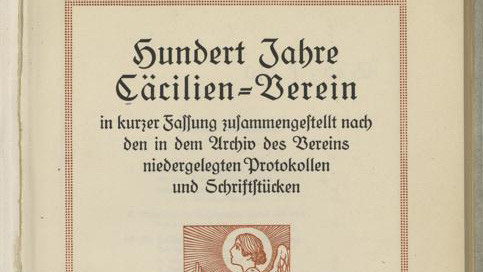
Photo: University Library Frankfurt
Nineteenth-century music collections held in the libraries of the Rhine-Main Universities (RMU) are set to become significantly more visible and accessible. In December 2025, the first joint project developed by the university libraries within the Rhine-Main Universities (RMU) alliance received funding approval. The initiative was launched by Prof. Dr. Klaus Pietschmann and Prof. Dr. Ursula Kramer from the Institute for Art History and Musicology at Johannes Gutenberg University Mainz (JGU).
The 18-month project will identify and catalogue historical music collections held by the university libraries in Frankfurt and Mainz, as well as the University and State Library in Darmstadt. At the same time, it will establish the foundations for a subsequent digitization proposal under the German Research Foundation’s (DFG) funding program “Scientific Library Services and Information Systems” (LIS).
Music as a Public Sphere in the Long Nineteenth Century in the Rhine-Main Region
The musical history of the Rhine-Main region during the long nineteenth century reflects a period of profound social and cultural change. Music became an increasingly visible part of public life and played a central role in the emergence of a bourgeois-liberal society. The region’s musical culture was shaped by the coexistence of traditional courtly institutions – particularly in Darmstadt – and a growing civic musical life in Frankfurt, Mainz and Darmstadt. This development found expression in major events that attracted both regional and national attention, including the Middle Rhine Music Festivals. At the same time, the Rhine-Main region established itself as a center of music with enduring national and international influence, fostered by figures such as Felix Mendelssohn Bartholdy and Clara Schumann, leading music publishers – most notably Schott – and renowned institutions including the opera houses and orchestras of Frankfurt, Darmstadt and Mainz.
Despite its significance, this chapter of musical history has received comparatively little scholarly attention. One of the most important resources for future research is the collection of nineteenth-century sheet music preserved in the RMU libraries.
Music Collections Between Card Catalogues, Sheet Music and Choral Archives
The project seeks to identify and provide initial scholarly access to the historical card catalogue of the music manuscript collection at the University and State Library (ULB) Darmstadt, together with the holdings of the Cäcilien Association Choir and the Rühl Choral Society preserved at Frankfurt University Library (UB). The Rühl Choral Society became part of the Cäcilien Association in 1925. In addition, the project will catalogue the archival collections of the Mainz Liedertafel Choral Society and the Women’s Choral Society held at UB Mainz, making important primary sources on the region’s musical and choral history accessible for research.
Integration into RISM and AI-Assisted Cataloguing
During the subsequent digitization and cataloguing phase, the printed music will be systematically catalogued, while digital reproductions will be incorporated into the Répertoire International des Sources Musicales (RISM), the international database of historical music sources. RISM is currently supported as a long-term academy project by Johannes Gutenberg University Mainz and Goethe University Frankfurt. The project will also evaluate AI-assisted and semi-automated methods for annotation and catalogue creation.
From Project Initiative to a Sustainable RMU Service Infrastructure
The methods developed during the project will be progressively integrated into the “Objects & Collections” service portfolio of the RMU Resource Center. The Resource Center forms part of the Rhine-Main Universities Alliance’s joint proposal submitted under Germany’s Excellence Strategy 2025.
Bringing together research expertise in musicology and theater studies with the services and infrastructure of the RMU libraries, the project serves as a pilot for deeper institutional collaboration across the alliance. It is guided by the principles of Open Science, promoting research that is transparent, accessible and reproducible. Through its interdisciplinary design and the close partnership between researchers as well as library and information infrastructure specialists, the project lays an important foundation for the strategic development of the Rhine-Main Universities Alliance.
Text: Franziska Voß (UB Johann Christian Senckenberg), Jonathan Gammert (UB Mainz)