Leadership development
Strengthening Leadership – Shaping the Future of RMU
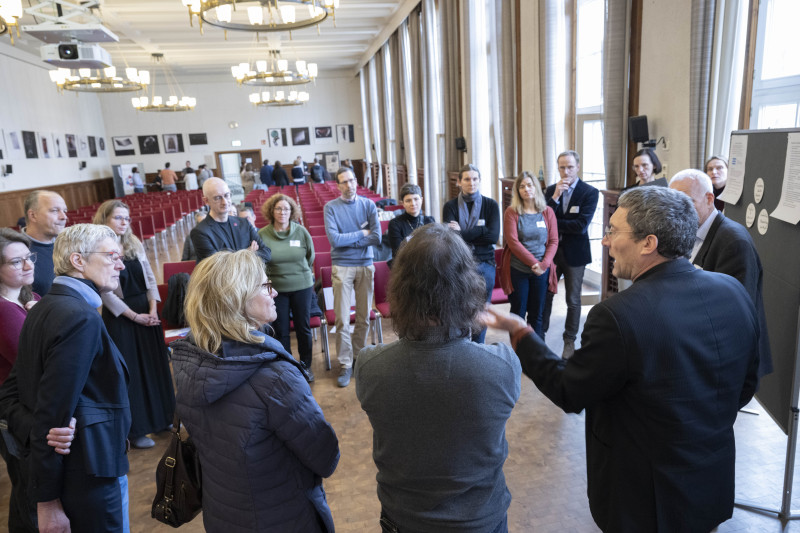
Leaders are key actors within universities. Hence, in a dynamic and increasingly complex environment, the targeted development of leaders is a decisive success factor for the RMU. We invest in the competencies of our leaders to foster collaboration, innovation, and transformation. Leadership connects—across locations, functional areas, and hierarchical levels—and creates the foundation for a high-performing and future-ready RMU.
Programs for Leaders
Leading Without Formal Authority
Leading without formal authority is associated with specific challenges—and plays a central role in the success of many university projects and initiatives.
Individuals working in lateral (subject-matter) leadership roles require specific competencies in order to effectively guide teams and projects without formal managerial power or decision-making authority.
Objectives and Content
This competency program introduces a range of effective methods and approaches to lateral leadership, with a focus on the following key topics:
- Taking stock: reflecting on lateral leadership responsibilities and strengthening role awareness
- Communication tools: purposefully developing and expanding communication skills
- Leading teams: understanding and guiding group dynamics
- Managing conflicts: confidently handling conflicts and difficult conversations
- Making effective decisions: steering and facilitating decision-making processes
The program consists of three interrelated modules with a total of 3.5 days of in-person training, as well as two integrated application and transfer phases designed to support the direct and effective transfer of learning into everyday work practice.
Through structured peer exchange, participants work on their own cases and challenges while building a strong and sustainable network within the RMU alliance.
Target Group
Employees from academia and administration who do not have disciplinary management responsibility but hold leadership roles and responsibilities (e.g., project managers, project coordinators, deputy heads of departments, groups, or teams).
Methodology
Preliminary consultation and needs assessment with HR-PEOE, expert input sessions, group discussions, individual and group work, practical exercises, peer case consultations, solution-oriented feedback, and learning partnerships.
Program Delivery and Support
The leadership program is offered by the Department of Human Resources and Organizational Development at Goethe University (HR-PEOE) and is delivered in cooperation with the Institute for Systemic Organizational and Career Consulting. Contact persons include Tina Vangelista, HR-PEOE, and Dr Caroline Kranabetter, Wengel und Hipp.
Development Program for Technical Leaders
Particularly in technical areas, work units are confronted with a wide range of challenges, including new tasks and technical requirements, increasing environmental complexity, and new job profiles and leadership positions. This results in higher demands on leaders.
The program aims to support both new and experienced leaders in technical areas (such as workshop supervisors, group leaders, and laboratory managers) in dealing more competently and flexibly with challenging leadership situations and in expanding their leadership skill set.
In addition to subject-specific and methodological input, exchange and active experimentation are central elements of the program. Across three modules, participants gain new insights into the following areas:
- Me as a leader: What is leadership? Leadership roles in technical environments; empowering staff
- Leading staff: actively shaping communication as a leader, managing staff, conducting staff appraisals
- The team perspective: team management, personal learning review, and feedback
Target Group
Leaders from technical areas such as workshops, laboratories, trades, construction and facilities management, and botanical gardens at the Rhine-Main Universities. When composing the group, care is taken to ensure that no direct colleagues participate in the same cohort.
Participation is only possible upon binding registration and requires attendance at all modules as well as participation in peer consultation in small groups.
Change Management Program for Leaders with Change Responsibility and Employees Leading Change Projects
Leaders and project managers are increasingly required to manage change initiatives in a rapidly evolving environment. The relevance and necessity of change management have long since increased at universities as well, presenting significant challenges for leaders and employees responsible for leading change initiatives. But how should change projects be planned and designed to ensure success? And how can those responsible become familiar with the fundamental principles, processes, and methods of change management?
Objectives and Content
The Change Management Program (CMP) provides methods to help design change processes more successfully. Participants strengthen their ability to act in a solution-oriented manner when dealing with typical process dynamics in change initiatives. They learn what matters in communication during change processes, how stakeholders can be involved effectively, and how to address tensions constructively and make productive use of them.
Participants develop an awareness of change management, reflect on their own responsibilities in change processes and projects, build relevant competencies, and learn to recognize when extended advisory and support needs are beneficial.
Methods
The program uses theoretical input, self-reflection, case studies, instructional videos, and case work based on current projects brought in by participants.
This program is exclusively intended for the development of a change project introduced by the participant. For a preliminary consultation, please contact Christoph Göbel, Tel.: +49 6151 16 26497, Email: christoph.goebel@tu-darmstadt.de
Trainers
Hans-Werner Bormann, WSFB Consulting Group
Christoph Göbel, Division VII D – Personnel and Organizational Development