- Collection
- Goethe University Frankfurt
Moulage Collection
- Life Sciences
- Natural Sciences
- Medicine & Medical History
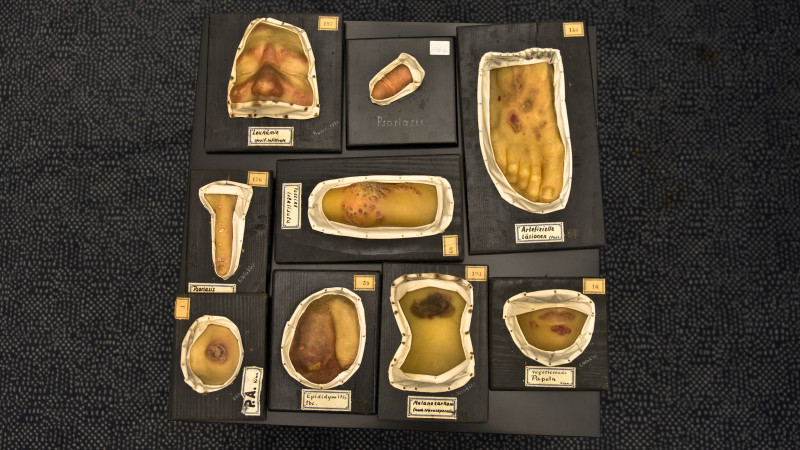
Selection of moulages. Photo: Tom Stern, Goethe University Frankfurt
In dermatology, a field with a strong morphological and descriptive focus, there has always been a search for patient-independent presentation options for teaching purposes. At the end of the 19th and beginning of the 20th centuries, moulage models were the preferred visual aids in dermatological teaching, but they were also used as deterrent representations to educate the population about the consequences of sexually transmitted diseases, which were quite common at the time. Moulages (wax models) are detailed, three-dimensional, lifelike wax models of diseased areas of the body. They were made as plaster casts directly from the patient and then filled with a wax-resin mixture to be artistically painted after hardening.
The University Dermatology Clinic has 228 moulages, the collection of which was started under the chairmanship of Karl Herxheimer (1861-1942). The oldest date back to 1904. They reflect a broad spectrum of dermatological conditions, with a particular focus on syphilis, skin tuberculosis, and skin tumors. Until Herxheimer's retirement, the collection was continuously expanded and a full-time moulageur (Ernst Winkler) was hired, who was responsible for most of the moulages still in existence today. At its peak, the collection comprised over 1,000 moulages, which were exhibited in a special room at the University Dermatology Clinic. Even today, the collection still contains several exhibits by some of Europe's most famous moulage artists, such as Jules Baretta (Paris), Alfons Kröner (Breslau), and Theodor Johnson (Freiburg).
Before the era of color photography, moulages were used as teaching materials for training students and continuing education assistants, but they were also frequently used at conferences to illustrate new or rare clinical pictures. Even in today's digital age, moulages have lost none of their fascination and continue to be used in teaching and for examination purposes, as their three-dimensionality is in some cases superior to color photography.