From ancient times into the future
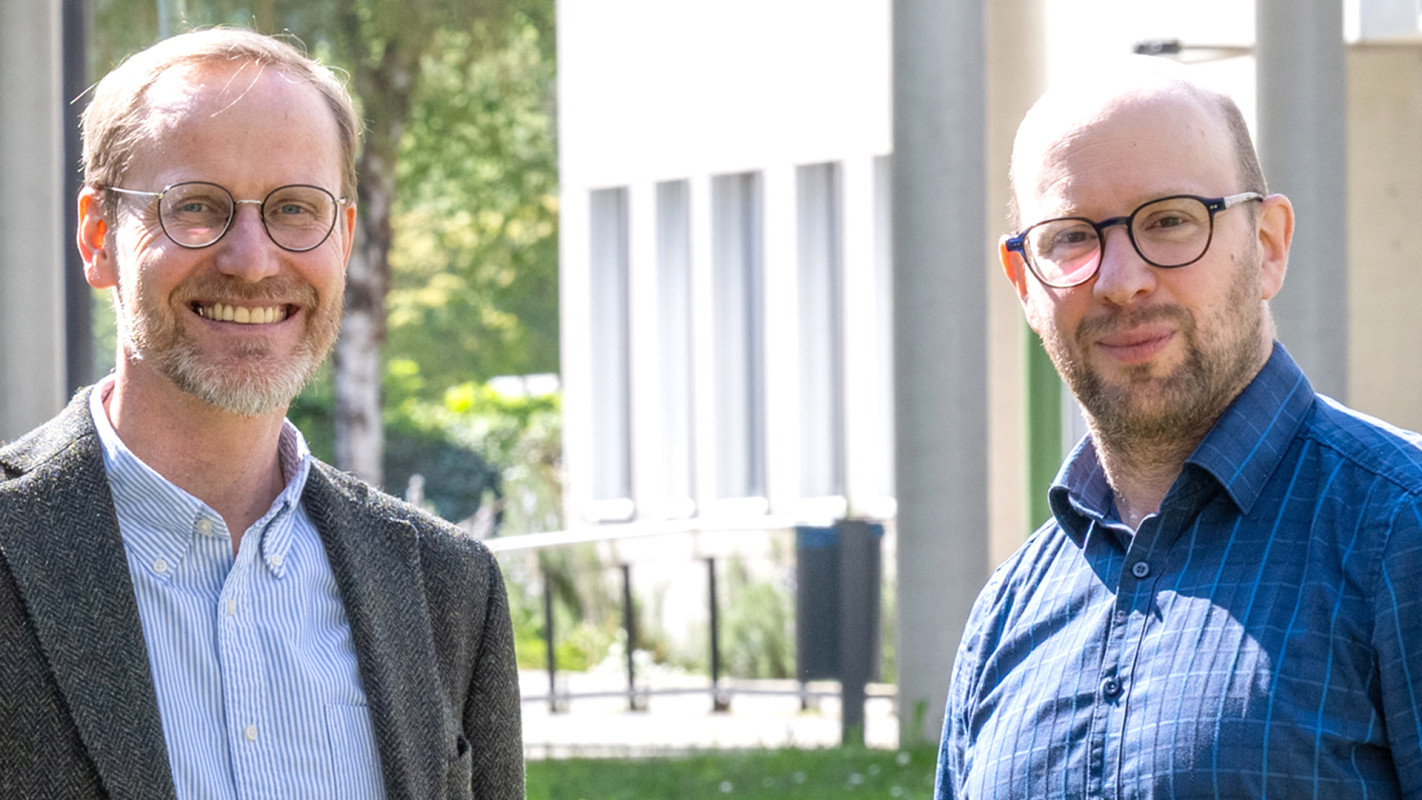
Professor Johannes Lipps (right) of Johannes Gutenberg University Mainz and Professor Dirk Wicke (left) of Goethe University Frankfurt, the current spokesperson and vice-spokesperson of VARM (photo/©: Peter Thomas / JGU)
For more than a decade, the Archaeology Network Rhine-Main (Verbund Archäologie Rhein-Main, VARM) has been pooling the diverse archaeological activities across the Rhine-Main region. Established by the Rhine-Main Universities in Mainz, Frankfurt and Darmstadt, other prestigious institutions have joined this hub of expertise. The collaborating partners work closely together in trans- and interdisciplinary exchange and projects and coordinate a range of activities in research and teaching focusing on antiquity and, specifically, archaeology.
Building a bridge from the distant past to our present day has been at the heart of VARM since it was founded in late 2015. This year's annual conference, to be held in late autumn, will extend that mission by addressing one of the most significant current developments in the field: The VARM Day 2026 will explore how artificial intelligence is transforming archaeological research.
VARM is one of the earliest success stories of the Rhine-Main Universities (RMU) alliance. Today, alongside Johannes Gutenberg University Mainz (JGU), Goethe University Frankfurt, and the Technical University of Darmstadt, the network includes the Leibniz Institute for Archaeology (LEIZA) in Mainz, the Roman-Germanic Commission of the German Archaeological Institute, the General Directorate for Cultural Heritage Rhineland-Palatinate, the State Office for the Preservation of Historic Monuments of Hesse, and the Archaeological Heritage Office of the City of Frankfurt. Its primary mission is to foster exchange and collaborative research in the subject of Ancient Studies.
Collaboration across disciplines
"Over the past ten years, the Rhine-Main Archaeology Network has become a strong alliance that brings together research and teaching as well as museum collections, the preservation of historic monuments, and cutting-edge non-university research," says Professor Dirk Wicke of Goethe University Frankfurt. Wicke has been involved with VARM from the very beginning – initially as a research associate at Mainz University and now as Professor for Near Eastern Archaeology in Frankfurt. He was the network's spokesperson for many years and is currently serving as its vice-spokesperson. "VARM has become a recognized brand. Our network enjoys an outstand reputation within archaeology," adds Professor Johannes Lipps, Professor of Classical Archaeology at JGU since 2019 and spokesperson for VARM since January 2026.
The founding vision of VARM in 2015 was to bring together the numerous archaeological institutions active in the Rhine-Main region to form an academic community and to strengthen collaboration within. "Archaeological disciplines and institutions should not simply exist alongside one another. They should combine their strengths through collaboration. That guiding principle continues to shape everything we do in VARM," emphasizes Lipps.
A flagship project for Germany
“Even before the network was formally established, there was a wealth of initiatives and projects in the field of Ancient Studies throughout the Rhine-Main region," Wicke recalls. "However, there was no systematic network of the individual institutions, and archeology simply wasn't as visible." And Lipps continues: "You can only make the best use of available expertise and opportunities if you know they exist."
The range of archaeological expertise across the region – from Mainz to Frankfurt and from Darmstadt to Wiesbaden – is remarkably broad. The research portfolio spans Classical and Provincial Roman Archaeology, ancient Near Eastern and Islamic Archaeology, African Archaeology, Prehistoric and Early Historic Archaeology as well as Historic Building Research, Numismatics and Archaeometry, with work taking place at universities and museums, in heritage preservation and research institutions alike.
As VARM spokesperson Professor Johannes Lipps stresses, it is this very concentration of expertise that makes the Rhine-Main region unique in Germany. "There is probably no other research hub in Germany that has so many archaeologists work in such close proximity across such a wide range of institutions." VARM uses this geographical advantage to generate a high level of academic productivity. "This could serve as a model for other academic disciplines."
Students at the participating universities also benefit directly from this collaboration. Mainz, Frankfurt, and Darmstadt offer a wide variety of specializations across their archaeological disciplines, while the network also provides access to internships in museums, in heritage preservation and international research projects at all three locations.
Cluster proposal as an important milestone
For both professors it is no coincidence that archaeology as a comparatively small academic field was among the first to establish a cross-state collaborative network within the Rhine-Main Universities. "If smaller disciplines want to preserve and expand the breadth of their research in the future, collaboration is essential," says Wicke. "The Rhine-Main Universities provide the ideal framework and environment for overcoming institutional boundaries."
A significant milestone for VARM came in 2019, when the network submitted a proposal for a Cluster of Excellence under Germany's Excellence Strategy program. Although the proposal was ultimately not approved, the application process significantly strengthened cooperation among all partners. "We refined our ideas, deepened our collaborations, and established the top-level research area "40,000 Years of Human Challenges" together with a coordination office set up in Mainz," reports Lipps.
Among the projects that have particularly benefited from VARM in recent years, the two spokespersons highlight research on Roman river landscapes in southern Hesse. The project has opened up new perspectives on the history of the Landgraben canal in the Groß-Gerau region. Evidence now suggests that it may have served as a waterway in Roman antiquity, rather than originating during the era of the Landgraves of Hesse, as previously postulated.
Artificial intelligence as valuable research tool
Since 2019, VARM has increasingly distinguished itself as a shared collaborative platform for archaeology throughout the Rhine-Main region. Clear evidence of the active exchange of ideas and the reach of the network was provided by the first VARM Day in November 2024 hosted by the Leibniz Institute for Archaeology in Mainz. More than 110 participants attended this debut event – an impressive response even surpassed at the 2025 VARM Day, entitled "Prospects for the Future", with 150 archaeologists present at Goethe University Frankfurt. The annual conference in 2026 at JGU will focus on the use of artificial intelligence in the archaeological disciplines.
"Digital methods and AI-based techniques and technologies have already become firmly established in our field," reports Professor Johannes Lipps. Examples include the digitization of inscribed clay tablets, providing automated interpretation of cuneiform script, image analysis, and object identification. In doing this, AI systems not only store enormous quantities of materials and data, but they also organize and classify them, making relevant information accessible for specific research purposes. "AI systems could well become our new archivists," Wicke says with a smile. At the same time, he emphasizes that archaeologists' expertise would not in any way become less relevant to research in the discipline. "The more data we have access to, the more important the skills become to appropriately categorize, interpret and evaluate them."
It is for this very reason that the two VARM spokespersons from Mainz and Frankfurt are determined to extend the network's mission beyond building bridges to antiquity, the ancient Near East, or the Middle Ages. They intend to prepare archaeology for the future by embracing new strategies, digital tools, and innovative gadgets.
Text: JGU Magazine