THE TRIPLE TRANSITION: EXISTENTIAL THREATS AS ORGANISATIONAL AND SOCIETAL CHALLENGES
Photos: Elssy Kiradjieva / Goethe University Frankfurt
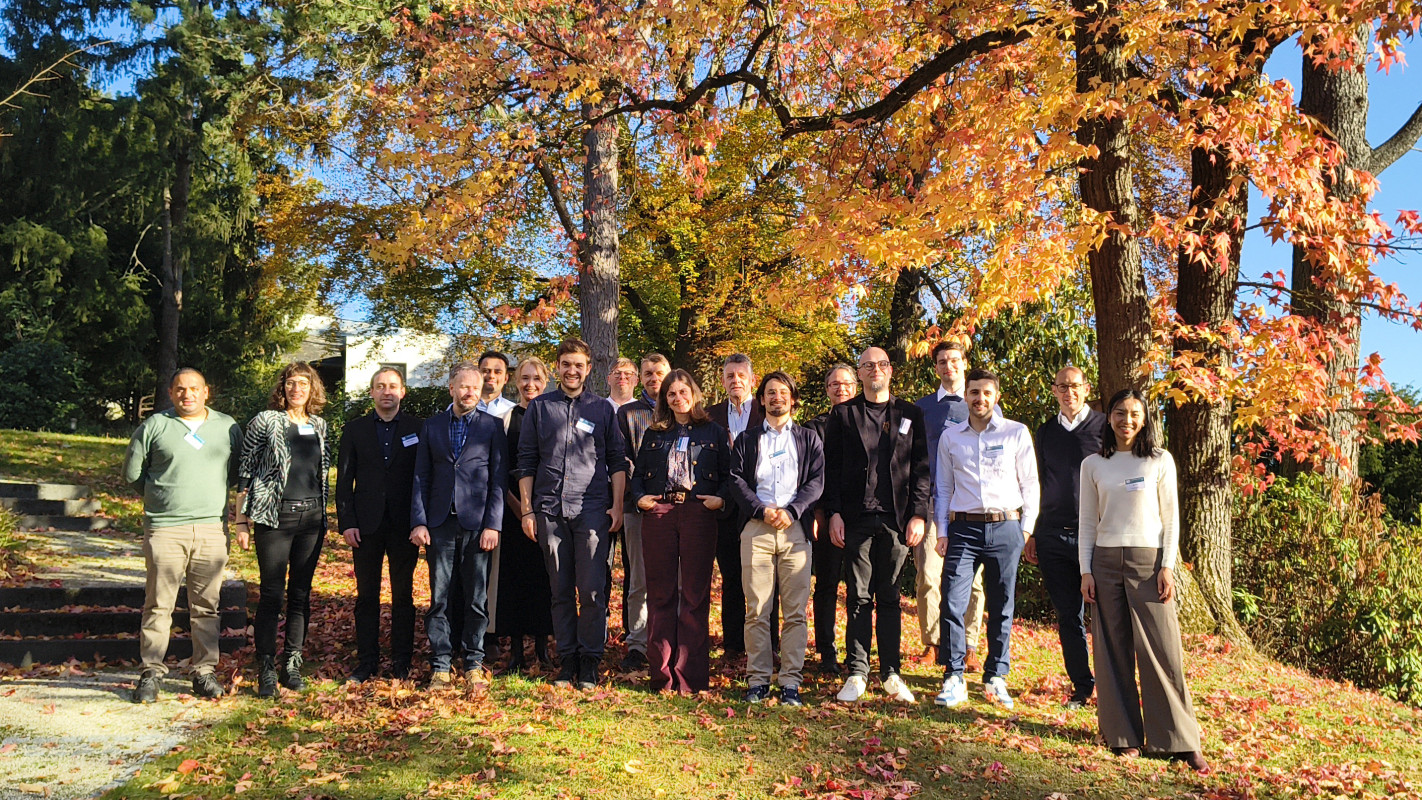
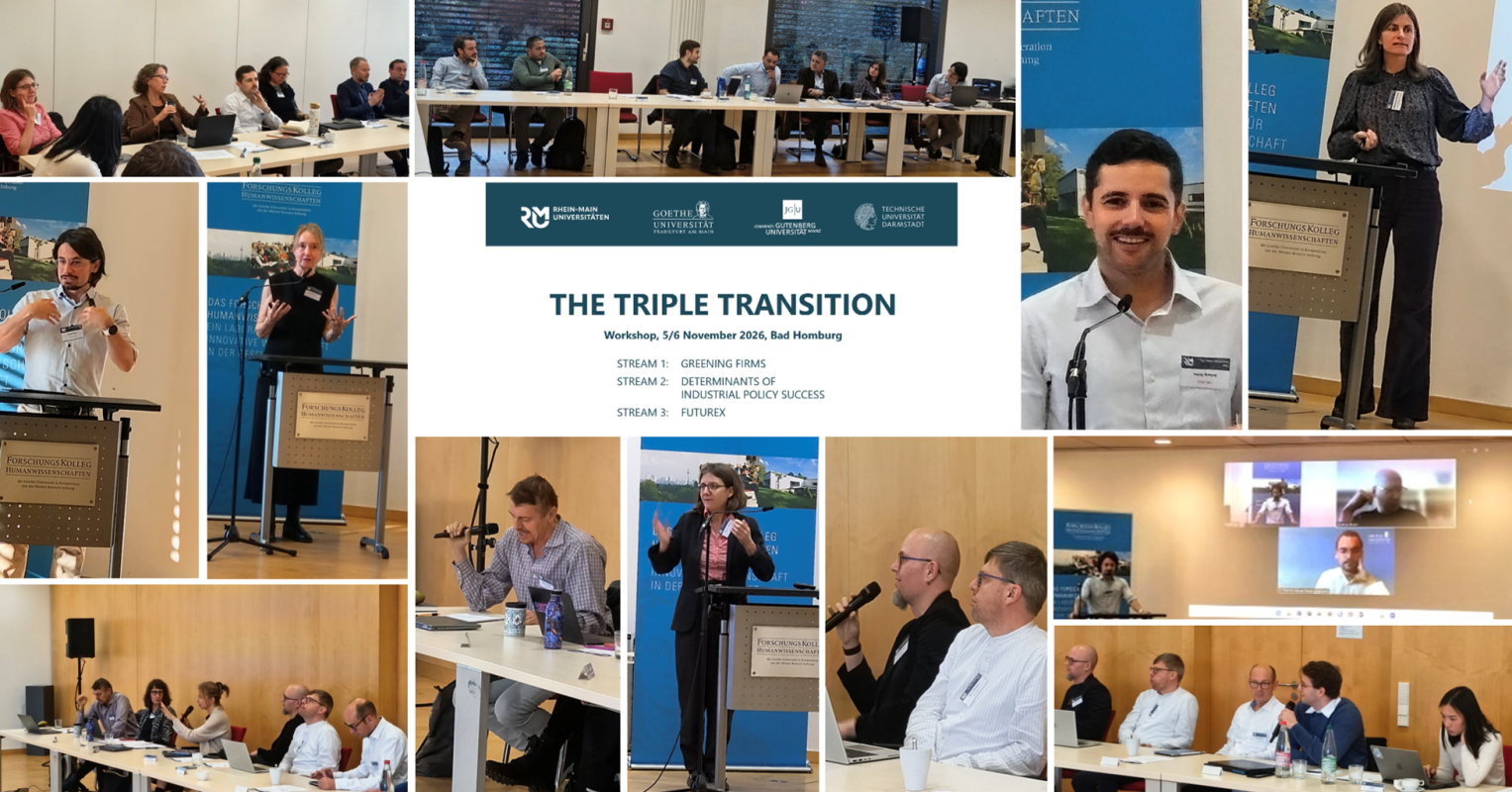
From 5 to 6 November 2026, the workshop ‘THE TRIPLE TRANSITION: EXISTENTIAL THREATS AS ORGANISATIONAL AND SOCIETAL CHALLENGES’ took place at the Forschungskolleg Humanwissenschaften in Bad Homburg. The workshop was part of the TTT – Thinking Tomorrow Today initiative of the Rhine-Main Universities (RMU).
Over the course of two intensive days, researchers from Goethe University Frankfurt, Johannes Gutenberg University Mainz, and the Technical University of Darmstadt were joined by external participants to discuss existential threats as challenges for organisations and society. Three thematic streams formed the core of the programme:
‘GREENING FIRMS’: How are companies changing their behaviour as part of the ecological transition? Cornelia Storz (Goethe University Frankfurt) discussed this topic with a focus on the role of the board-emission relationship, and Frank Pisch (Technical University of Darmstadt) with a focus on the local environmental footprint of global value chains.
Alongside the presentations and discussions, a particularly inspiring highlight was the keynote speech by Lucas Amaral (IÉSEG School of Management, Paris) on the role of sustainability committees for the ecological transformation.
‘DETERMINANTS OF INDUSTRIAL POLICY SUCCESS’: What determines whether industrial policy succeeds? What is the role of publicly provided infrastructure? Helen Callaghan and Bob Hancké (both from Johannes Gutenberg University Mainz) focused their presentations on these questions.
The session was further enriched by a keynote from Kathrine von Graevenitz (ZEW – Leibniz Centre for European Economic Research, Mannheim) on the ETS-industrial policy relationship.
‘FUTUREX’: How can we imagine, research and shape the future? The presentations by Sascha Dickel (Johannes Gutenberg University Mainz) and Thomas Scheffer (Goethe University Frankfurt) offered stimulating insights into existential crises, including artificial superintelligence.
Prof. Dr. Cornelia Storz and Prof. Dr. Frank Pisch, who hosted the workshop, emphasize: "Special thanks go to our two external speakers, Lucas Amaral and Kathrine von Graevenitz, for their inspiring contributions!
We would also like to thank all speakers, discussants and supporters for the open and stimulating exchange across disciplinary and university boundaries:
- Goethe University Frankfurt: Benedikt Bender, Matthias Breuer, Alexander Ebner, Aaron Kaegi, Manuel Linsenmeier, Johannes Petry, Aurora A. Sauter, Michael Schedelik, Thomas Scheffer, and Tim Seitz;
- Johannes Gutenberg University Mainz: Helen Callaghan, Sascha Dickel, Andreas Dimmelmeier, Benjamin Doubali, Claudia Göbel, Bob Hancké, Muhammad Osama Iqbal, Marc Mölders, and Moritz Wassum;
- Technical University of Darmstadt: Nina Keith, Michèle Knodt, and Stefan Niessen; Ali Aslan Gümüsay (Ludwig Maximilian University of Munich); Youssef Ibrahim (University of Hamburg); Torben Schubert (Fraunhofer Institute for Systems and Innovation Research ISI); Robin Sogalla (University of Mannheim); Na Zou (University of Bath).
We look forward to everything that will grow out of these conversations, including the potential for new connections, insights, and opportunities."
Text: Prof. Dr. Cornelia Storz und Prof. Dr. Frank Pisch