- Graduate School
DFG Research Training Group "Aesthetics of Democracy"
- Humanities and Social Sciences
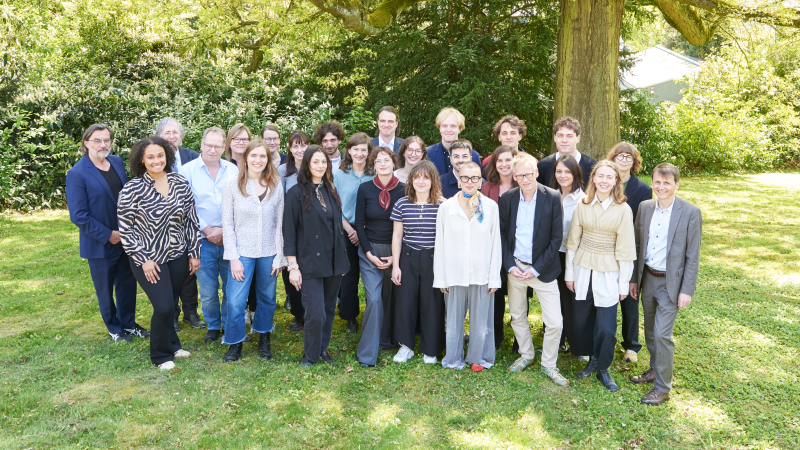
Is democracy something we can experience with our senses? Does it have a distinct aesthetic of its own, comparable to the aesthetics of totalitarianism? Does democratic coexistence take on a particular form? These are the questions explored by the DFG-funded Research Training Group 3113, “Aesthetics of Democracy.” During its initial five-year funding period, 24 doctoral researchers from a wide range of humanities disciplines at Goethe University Frankfurt and TU Darmstadt work together in an interdisciplinary setting. Through accompanying public humanities projects, they also engage in dialogue with broader audiences.
In both public discourse and academic scholarship, democracy is typically understood as a form of government: a set of institutions and procedures through which political interests are formed, articulated, and represented. The Research Training Group “Aesthetics of Democracy,” by contrast, asks what it means to conceive of democracy not only as an institutional order but as a lived form of collective coexistence. This shift directs attention to modes of association that unfold below the level of the state and, in this sense, need not be confined to “actually existing democracies.” Such forms may emerge in art and culture, but also in clubs, associations, or fleeting encounters in public space. The group’s guiding hypothesis understands democracy as an open, reflexive mode of living together, shaped by ongoing public contestation over how it ought to be organized. The negotiation of its form is itself its form. In aesthetic terms, this means that democracy is something that can be experienced—sensuously as well as conceptually— while at the same time being marked by struggles over the very shaping of the sensible.
At the heart of this hypothesis lies an internal tension: between institution and instituting, between the stabilizing force of established forms that provide continuity and orientation, and the dynamic force of their continual renegotiation and transformation. This observation leads to the overarching question of the Research Training Group: how can the tension between form and re-formation be specified in relation to particular objects of study, and what sensuously perceptible forms does this tension itself assume?
Our premise is that different forms of democratic association are by no means defined by harmony alone. Rather, they are consistently marked by conflict, disagreement, and an irreducible plurality of competing perspectives. The everyday practices and experiences of living together—whether in consensus or in conflict—form the basis for the stability, revitalization, and ongoing transformation of democratic life. Questions about the future viability and resilience of democracy, including beyond its current and by no means uniform institutional configurations, therefore require a more precise understanding of the forms of democratic coexistence.