- Research Project
Hadrons and Nuclei as Discovery Tools – CRC 1660
- Natural Sciences
- Engineering Sciences
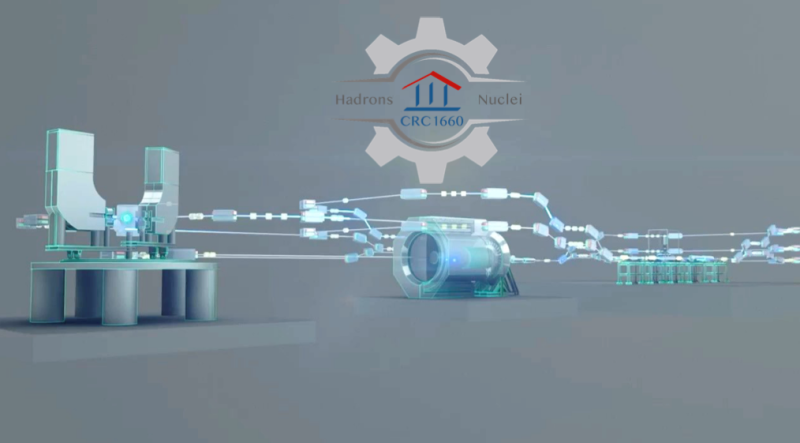
Collaborative Research Center 1660 establishes Mainz as an internationally visible hub for precision tests of fundamental physics. The CRC exploits hadrons and nuclei as highly sensitive probes to search for new physical phenomena. By tightly integrating atomic, nuclear and hadron physics, it creates an interdisciplinary research program with outstanding discovery potential.
A unique cornerstone of CRC 1660 is the new MESA accelerator in Mainz, enabling world-leading low-energy precision experiments. MESA forms the backbone of many key projects and opens unprecedented opportunities for measurements beyond current limits. This program is complemented by experiments at MAMI and at international facilities such as PSI and BESIII.
The research program is structured around three closely connected pillars. The first pillar focuses on high-precision low-energy experiments at MESA searching for new particles and interactions beyond the Standard Model. These include world-leading measurements of the weak mixing angle, systematic searches for dark matter and dark sector particles, and studies of deviations in the muon’s anomalous magnetic moment. These measurements provide complementary information to high-energy experiments at the LHC and probe new physics scales up to several tens of TeV.The second pillar aims at a highly precise theoretical description of hadronic processes, essential for the interpretation of future neutrino experiments and muonic atom spectroscopy. Advanced theoretical approaches – including effective field theories, dispersive methods and lattice QCD – are closely linked in Mainz to experimental programs at MESA and MAMI. The goal is a substantial reduction of theoretical uncertainties currently limiting experimental precision. The third pillar performs a new generation of high-precision nuclear physics experiments at MESA addressing key questions of the nuclear equation of state, nucleosynthesis and multi-messenger astronomy. These include measurements of neutron skins in heavy nuclei, studies of astrophysically relevant reaction rates and precision tests in few-body systems.
CRC 1660 is characterized by an exceptionally close collaboration between theory and experiment at the Mainz site. The unique infrastructure centered around MESA gives Mainz a globally visible profile in precision physics.
In addition to Johannes Gutenberg University Mainz, CRC 1660 also involves the Helmholtz Institute Mainz (HIM) as well as Goethe-University Frankfurt and the University of Münster.