From Quark Matter to Neutron Stars
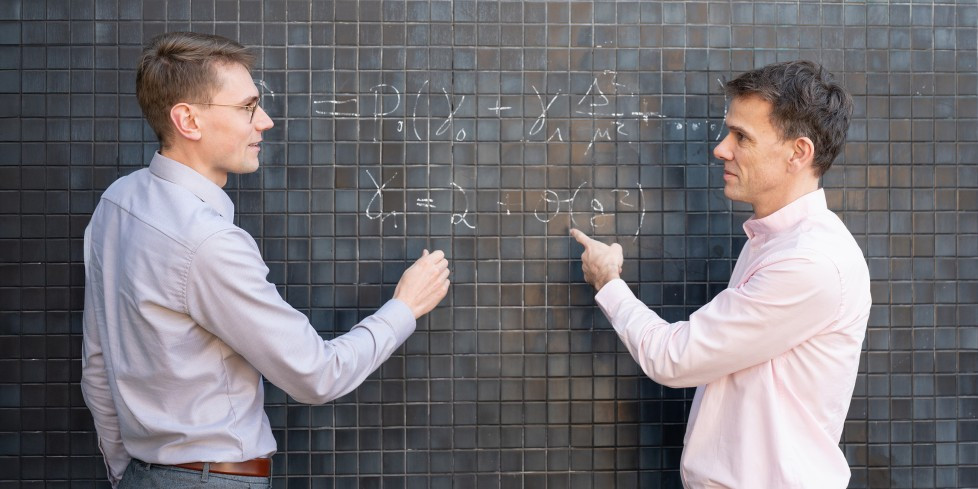
Dr. Andreas Geißel (le.) and Professor Dr. Jens Braun (ri.) Photo: Patrick Bal
Describing matter under extreme conditions, such as those found inside neutron stars, remains an unsolved problem. The density of such matter is equivalent to compressing around 100,000 Eiffel Towers into a single cubic centimeter. In particular, the properties of so-called quark matter – which consists of the universe’s fundamental building blocks, the quarks, and may exist in extremely dense regions—play a central role. Researchers from TU Darmstadt and Goethe University Frankfurt have studied this matter and its thermodynamic properties. Their results have now been published in the renowned journal “Physical Review Letters”.
Theoretical studies suggest that quarks at very low temperatures enter a so-called color-superconducting state, which fundamentally alters the nature of matter. This state is analogous to the transition of an electron gas into an electrical superconductor – except that, instead of electrons, quarks pair up and create an energy gap in their excitation spectrum. Unlike conventional superconductors, however, a color superconductor generally does not conduct electric current without resistance, but rather the color charge of the quarks. This charge ultimately determines the strength of the interaction between these elementary building blocks of matter.
The formation of quark pairs and the resulting energy gap fundamentally change the behavior of matter. Even relatively weak pairing effects have a significant impact on the matter and its thermodynamic properties.
Andreas Geißel, Tyler Gorda, and Jens Braun analyze these effects in detail. They calculate correction terms arising from quark pairing and interactions, while accounting for the specific conditions inside neutron stars. This allows the research team to determine both the thermodynamic pressure and the speed of sound in color-superconducting quark matter.
A significant increase in the speed of sound
The results show that the color-superconducting state is thermodynamically favored at high densities. Moreover, this state leads to a significant increase in the speed of sound – a direct measure of the mechanical stability of matter. According to the calculations, the speed of sound in the interior of neutron stars could exceed 60 percent of the speed of light, i.e., more than 180,000 kilometers per second. This figure becomes even more impressive when compared to the speed of sound in the hardest terrestrial “everyday material”, diamond, which is 10,000 times lower.
Numerical simulations also suggest that such high speeds of sound are necessary to explain the stability of the most massive known neutron stars. The work by Geißel, Gorda, and Braun now suggests that color-superconducting matter may be a crucial ingredient in explaining massive neutron stars – and that observations of these stars could, in turn, help to better constrain the energy gap in the quark spectrum.