Research during your studies: ‘Excellence Track Algebra’ launched
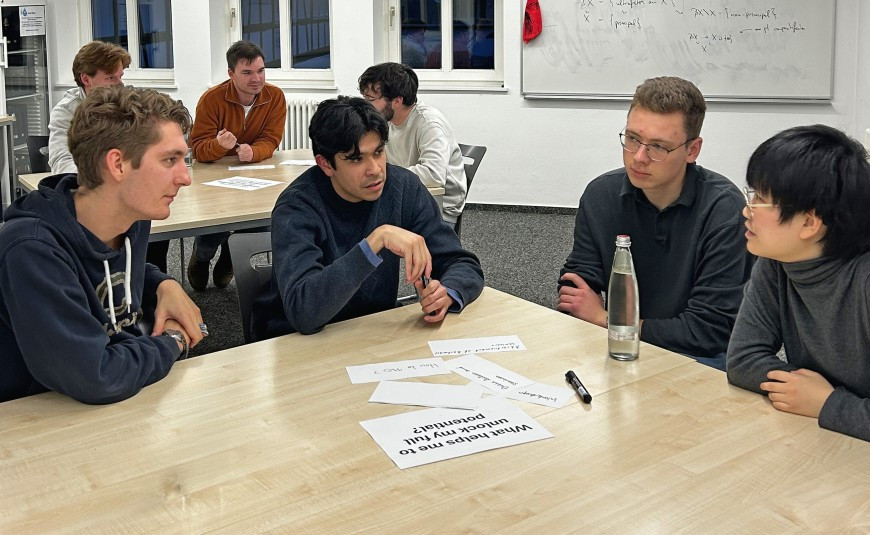
Bild: SFB GAUS
The Collaborative Research Centre ‘GAUS’ has been researching complex geometric and arithmetic objects since 2021. The Rhine-Main Universities Goethe University Frankfurt (as coordinator), TU Darmstadt and Johannes Gutenberg University Mainz (as associate partner) as well as the University of Heidelberg are involved. For the 2025/26 winter semester, the ‘Excellence Track Algebra’ has now been established as an in-depth, research-oriented programme for Master's students. Professor Timo Richarz presents the programme in an interview.
Mr Richarz, what is the concept and content of the programme?
Timo Richarz: The Excellence Track Algebra (ETA) is a research-oriented supplementary programme for Master's students with a special interest in algebra. It expands the course of study with a cross-university programme of specialised lectures and seminars at the Darmstadt, Frankfurt, Heidelberg and Mainz campuses. At the same time, it creates a committed peer community that engages in intensive exchange and networking in joint workshops and retreats. Early involvement in research groups at the Collaborative Research Centre (CRC) GAUS enables scientific practice and personal contacts and creates the best conditions for master's theses, doctorates and research.
What are the experiences from the first semester?
Timo Richarz: The ETA was launched in the winter semester of 2025/26 as a soft launch, i.e. without much publicity. Since then, we have been developing it further together with committed students from all universities and implementing many ideas step by step. The high level of motivation among the participants and their intensive professional exchange, both among themselves and with researchers from the participating universities, are particularly impressive.
A particular highlight was the ETA retreat in December. In addition to scientific lectures, the main focus was on getting to know each other personally. Joint activities such as hikes, game evenings and a gingerbread house competition brought students from different locations closer together.
How will the programme continue?
Timo Richarz: The Excellence Track is constantly being developed, and we are happy to take participants' wishes into account. The next step is to link up with the GAUS CRC Colloquium: students prepare the presentations in advance and discuss them in small groups to clarify any questions. They then attend the colloquium together with GAUS members from all locations.
There will also be an open exchange with doctoral students, where questions about doctoral studies and everyday academic life can be discussed in a relaxed atmosphere. This allows young scientists in the RMU region to establish contacts at an early stage, gain insights into research practice and receive guidance for their future careers.
The Excellence Track is a joint project between the Rhine-Main Universities (TU Darmstadt, Goethe University Frankfurt, Johannes Gutenberg University Mainz) and Heidelberg University. How is the collaboration going, and to what extent are the network and geographical proximity an advantage?
Timo Richarz: The close collaboration between the Rhine-Main Universities and Heidelberg is a real asset for the Excellence Track. TU Darmstadt, Goethe University Frankfurt, the University of Mainz and the University of Heidelberg contribute different algebraic specialisations and offerings.
The geographical proximity allows students to easily attend courses at different universities and participate in joint formats in person. This creates a dense academic network that offers students early access to diverse expertise and creates a shared research environment that extends far beyond a single location.
The questions were posed by Claudia Staub.
‘Excellence Track Algebra’
The ‘Excellence Track in Algebra’ is part of the CRC GAUS and complements the Master's programme in Mathematics offered by the participating partners. The programme is aimed at students who wish to specialise in algebra as part of their Master's degree and embark on a career in research at an early stage.
Collaborative Research Centre ‘GAUS’
The CRC ‘Geometry and Arithmetic of Uniformised Structures’ (GAUS) researches difficult mathematical spaces from geometry and number theory. A central tool is uniformisation. This involves replacing a complicated object with a simpler model that looks the same locally.
The original complexity does not disappear but is reflected in the symmetries of the model. This allows difficult problems to be viewed in a different mathematical language.
With this approach, the researchers aim to gain new insights into the structure of geometric and arithmetic spaces and to better understand fundamental relationships in mathematics.
The CRC was proposed by Goethe University Frankfurt, TU Darmstadt and Heidelberg University, with Johannes Gutenberg University Mainz and the University of Münster as associated institutions.
Professor Timo Richarz
Timo Richarz has been Professor of Algebraic Geometry and Number Theory at the Department of Mathematics at TU Darmstadt since 2019. He heads two sub-projects in the CRC GAUS and, together with Professor Manuel Blickle from Johannes Gutenberg University Mainz, is the initiator of the Excellence Track Algebra. He has received several awards for his work, including an ERC Starting Grant and a LOEWE Start Professorship.
An article in the magazine ‘Forschung Frankfurt’ provides an example of the questions being addressed within the CRC: In it, a Principal Investigator at the CRC, Professor Annette Werner from Goethe University Frankfurt, explains the basics of p-adic geometry – a central tool of modern number theory. The ‘Excellence Track Algebra’ also focuses on this area of research and involves Master's students in the cross-location work of the network at an early stage.