RMU Research Training Group meets for mid-term conference
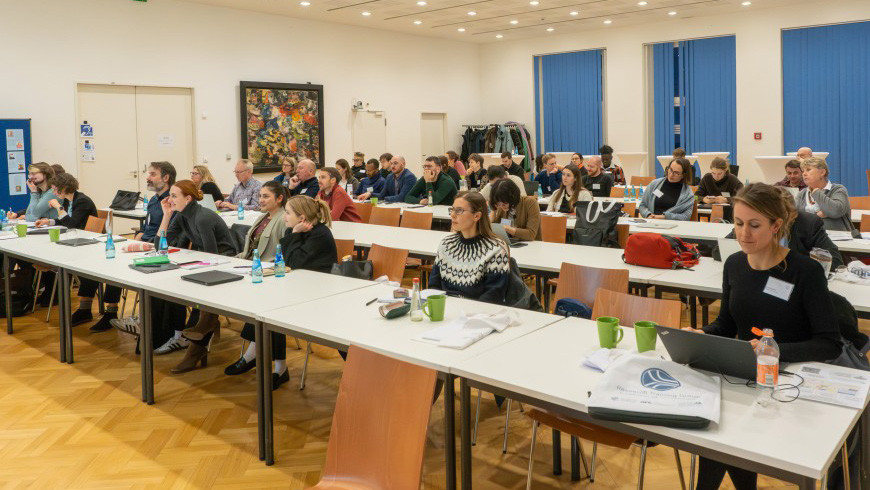
Mid-term conference of the RMU Research Training Group (Photo: Timo Alexander Richter)
Since 2023, the Research Training Group ‘Standards of Governance’ at TU Darmstadt and Goethe University Frankfurt has been conducting research on the concept of ‘good governance’. At a conference, the researchers exchanged ideas on their research questions – ranging from supply chain legislation to forest protection. Spokesperson Professor Jens Steffek provides insight in an interview.
Mr Steffek, under the motto ‘Standards, Governance and Global Transformations’, the Research Training Group ‘Standards of Governance’ met at Goethe University Frankfurt at the end of January for its midterm conference. What were the key points of the programme for you?
I always find it fascinating to see in how many policy areas standards play a major role, from the regulation of global financial markets and the transparency of supply chains to the fight against corruption and the promotion of equal opportunities. I filled an entire notebook with notes during the presentations, which, to be honest, doesn't happen very often at conferences. My notes also contain lots of strange abbreviations, which is typical for conferences on standards. At first glance, some of these topics seem quite technical and detailed, but behind the technical details there are often quite big political and social issues. It's great fun to work out these issues. I was also very pleased to host a good number of international experts at the mid-term conference whose names I had previously only known from the literature.
Were the first results of the research conducted by the Research Training Group presented at the conference, for example on important core issues such as the emergence, dissemination, operationalisation and enforcement of standards of governance?
The mid-term conference was largely organised by our doctoral students together with our post-doc Julia Drubel. It was really interesting to see how our Research Training Group is developing and how the young generation of researchers is setting its own agenda. And, of course, there were also insights into the results of the research work as part of the programme. Much of it was extremely topical, such as the struggle for supply chain regulation in the European Union or the efforts to better protect forests with the help of sustainable management standards.
What special significance do standards have as instruments of governance in today's world, for example with regard to current global crises?
One probably has to differentiate here. Technical standards are extremely important in a globalised, digital economy and reflect global power relations. This is demonstrated not least by China's strategy of influencing international standard-setting much more strongly than in the past. In the area of sustainability, much can be achieved with product standards that create transparency and credibility, but also with procedural standards that require the systematic inclusion of environmental aspects in decision-making. However, standardisation is certainly not a panacea. Military threats from aggressive, revisionist states cannot be countered with standards.
‘Standards of Governance’ is a joint RTG project between RMU partners TU Darmstadt and Goethe University Frankfurt. How is the collaboration going, and to what extent are the network and geographical proximity an advantage?
In practice, the day-to-day collaboration between the two universities now runs smoothly. It also has a long tradition in our academic disciplines. We have been offering joint Master's programmes in Political Theory and International Studies / Peace and Conflict Research since 2007. Back then, the aim was to combine the existing strengths of the two universities in order to be able to offer outstanding study programmes. Our research training group also benefits from the existence of these programmes, not least because many processes between the administrations are well established. And in the field of research, because we can recruit excellent student assistants from these programmes and now also the first doctoral students.
What are the next steps for the GRK, how will it continue?
At the moment, we are already working intensively on possible new areas of focus in research on standards. DFG research training groups consist of two funding phases. At the beginning of next year, we will have to submit a continuation application in which we outline an agenda for the coming years. We are currently thinking about this together with the doctoral students. One topic that is almost certain to come up is the increasing contestation, i.e. questioning, of standards of good governance by autocratic rulers and populists such as US President Donald Trump, who cares little about the rule of law and is also attempting to break with sustainability and diversity-related standards – with consequences far beyond the US.
The questions were posed by Michaela Hütig.
The Research Training Group ‘Standards of Governance’
The Research Training Group ‘Standards of Governance’ at Goethe University and TU Darmstadt has been funded by the German Research Foundation (DFG) since 1 April 2023 for an initial period of five years with 4.4 million euros. It may then be continued for a further four years.
The programme is dedicated to the question of how ‘standards of governance’ change the possibility of collective self-determination. It is interdisciplinary in nature and serves to train early career researchers. Jens Steffek, Professor of Transnational Governance at TU Darmstadt, is the spokesperson, and democracy researcher Professor Sandra Seubert from Goethe University is the deputy spokesperson.
Both universities are involved with five principal investigators each from the fields of political science and sociology, philosophy and law. Goethe University and TU Darmstadt belong to the Rhein-Main Universities (RMU) university network and offer the cross-location master's programmes ‘International Studies, Peace and Conflict Research’ and ‘Political Theory’.
The innovative guiding principle of the Research Training Group is to understand norms of good governance as standards – comparable to technical standards – and to analyse them. Through interdisciplinary collaboration and a combination of empirical-analytical and normative research, the group addresses questions such as how standards of governance arise and why they are codified. By combining research perspectives that are not normally considered together, the programme also aims to foster dialogue between political theory and institutional studies and disciplines such as political economy, international relations, law and sociological modernisation research.