Video interview provides insight into the new Master's program in Particle Accelerator Science at Rhein-Main Universities (RMU)
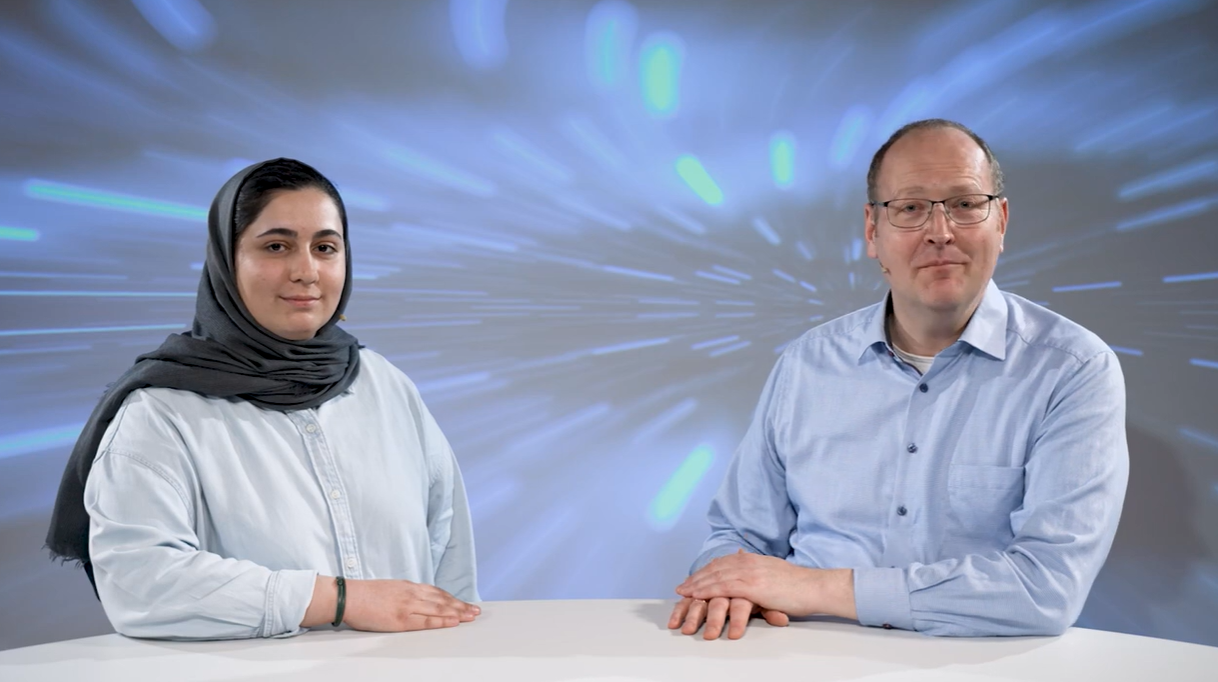
Photo: Prof. Dr. Joachim Enders and physics student Fatemeh Moujani
What fascinates young scientists about particle accelerators? What research opportunities does the Rhine-Main region offer? And why is a separate master's program for accelerator science necessary? Prof. Dr. Joachim Enders and physics student Fatemeh Moujani provide answers to these questions in a new video interview about the master's program in Particle Accelerator Science at the Rhine-Main Universities.
From basic research to cancer therapy
“Particle accelerators are a huge inspiration for me,” explains Fatemeh Moujani, who wrote her bachelor's thesis at the in-house accelerator S-DALINAC. In conversation with Professor Joachim Enders, she describes the diverse fields of application: from groundbreaking discoveries at CERN's Large Hadron Collider to materials research with synchrotron radiation and medical applications in cancer therapy.
Unique research opportunities on site
A special feature of the program is the opportunity for students to conduct research directly on particle accelerators. “Darmstadt has the unique feature that students can operate and further develop the particle accelerator themselves – as part of their theses or research projects,” says Moujani. She herself worked on simulations of beam dynamics for an energy recovery linac – a sustainable accelerator technology that allows energy to be recovered.
Expertise from three universities combined
In an interview, Professor Enders explains the collaboration between the RMU partners: While Darmstadt and Mainz are both conducting research into energy recovery linacs, Frankfurt contributes its many years of experience with ion accelerators. This expertise is being directly incorporated into the large-scale research facility FAIR (Facility for Antiproton and Ion Research), which is currently being built just north of Darmstadt.
“For the first time, we are now combining the expertise from Mainz, Darmstadt, and Frankfurt into a coherent range of courses,” emphasizes Enders. Students take courses at all three universities and are taught by the respective experts in their specialist areas.
Interdisciplinary and international
The interdisciplinary nature of the program reflects the complexity of modern particle accelerators: “On the one hand, we have the laws of physics that determine the trajectories of the particles. On the other hand, we have to develop components using engineering methods, perform simulations, and control the entire system with computer-aided processes,” explains Moujani.
For her, the new degree program was long overdue: “Until now, I had to travel to different countries in Europe and Asia to gather this knowledge piece by piece – it wasn't available in Germany.” The new master's program closes this gap and trains urgently needed specialists for research institutions such as FAIR, GSI, CERN, and DESY.
The English-language master's program will start in the summer semester of 2026 with an initial 20 places and is aimed at bachelor's graduates in physics and related subjects – both from the region and internationally.