- Research Project
Damage control by the stroma-vascular compartment – CRC 1531
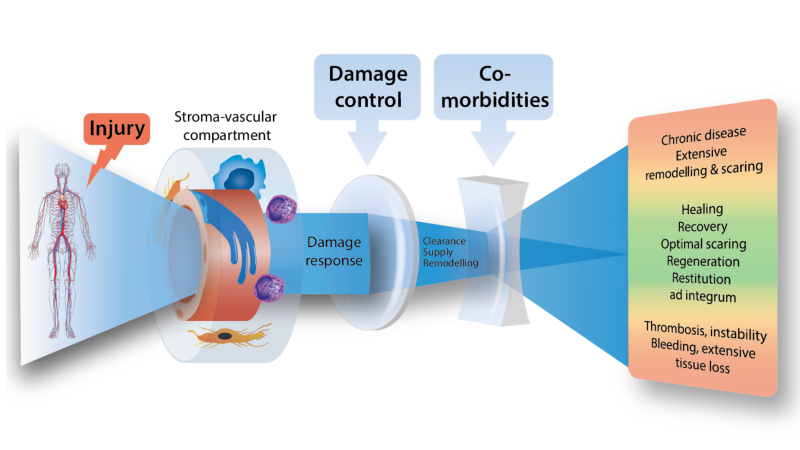
The stroma-vascular compartment (SVC) is an integral part of each organ. It provides the scaffold and support structures for the specific parenchymal cells, and contains blood and lymphatic vessels as well as stroma cells. The response of an organ to insult or damage critically depends on the SVC as cells therein act as first responders and as it is the space into which inflammatory cells egress from the blood. In response to damage fibroblasts within the SVC proliferate and differentiate to generate new extracellular matrix and angiogenesis, the formation of new blood vessels, is stimulated to re-establish nutrient supply.
By focussing on the SVC of the heart, the brain and blood vessels, the collaborative research centre (CRC) “Damage control by the stroma-vascular compartment” aims to understand how different cell populations within the SVC respond to damage and contribute to the reparative response. Research on this compartment has been limited to-date largely because of the large number of different cells contained therein, their plasticity and the complicated dynamics of the damage response. Advances in mass spectrometry, single cell sequencing, spatial transcriptomics and bio-informatics (all of which are provided by service projects within our CRC), now mean that it is possible to address the kinetics of complicated inter- and intra-cellular mechanisms after damage.
The consortium is interested in the mechanisms and molecular players that orchestrate the response to injury in a multi-cellular context. Its aim is to identify how the interplay between different cell types is coordinated during the damage response and how it is compromised by comorbidities. The identified mechanisms shall ultimately be exploited to promote repair and the restoration of function.