From Campus to Career: How the Rhine-Main Region Is Working to Retain International Talent
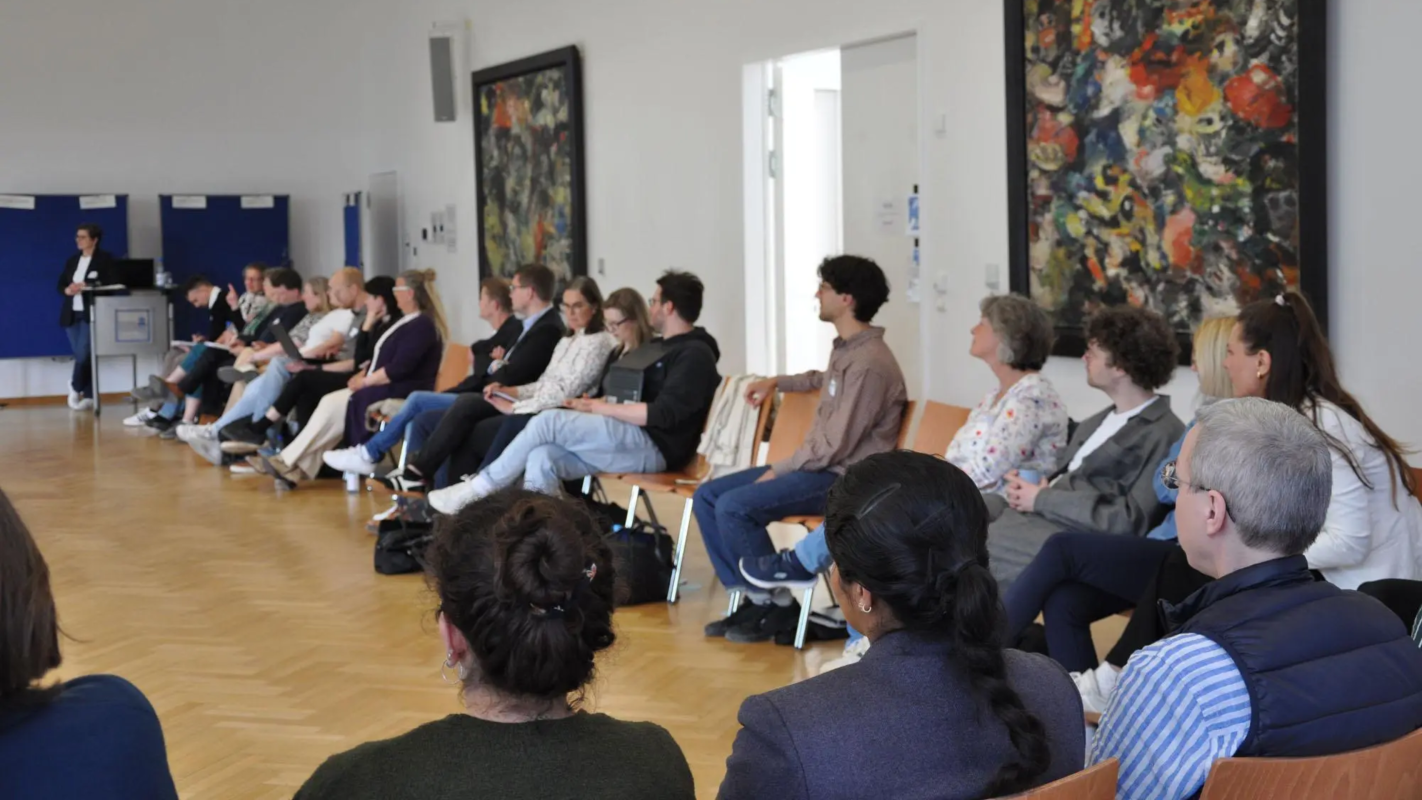
Alongside updates from the project’s various working groups, participants exchanged experiences, discussed current challenges and developed new ideas for supporting international students and graduates on their path from higher education into employment.
International Career Service Rhine-Main Takes Stock at Halftime
In early May, representatives from universities, businesses, public authorities, professional associations and labor-market institutions gathered at Goethe University Frankfurt’s Westend Campus for the sixth roundtable meeting of the International Career Service Rhine-Main (ICS RM). At the heart of the discussions stood a question that is becoming increasingly urgent in light of demographic change and evolving labor-market conditions: How can international students successfully transition into the German labor market and build long-term careers in the Rhine-Main region?
The full-day workshop brought together around 60 participants and marked the halfway point of the five-year project.
The International Career Service Rhine-Main
The International Career Service Rhine-Main (ICS RM) is a collaborative initiative involving the major public universities and universities of applied sciences in the Rhine-Main region. Funded by the European Social Fund, the State of Hesse and contributions from the participating public universities, the project runs from 2023 to 2028. The consortium includes Goethe University Frankfurt, TU Darmstadt, Frankfurt University of Applied Sciences, RheinMain University of Applied Sciences and Darmstadt University of Applied Sciences. In addition, Johannes Gutenberg University Mainz is associated with the project as a partner institution. Together, these institutions educate approximately 25,000 international students, as well as another 25,000 students with migration backgrounds. Through workshops, coaching, mentoring programs, career guidance, networking opportunities and a wide range of support services, ICS RM aims to strengthen students’ prospects in Germany and help employers connect with highly qualified international talent. An operational roundtable and a strategic advisory board support the project’s development and help address structural barriers affecting international students and graduates across the region. Through its regional scope and cross-institutional collaboration, ICS RM represents a unique model within Germany’s higher-education landscape.
Skilled Labor Shortages Remain a Long-Term Challenge
While the workshop focused on dedicated topics and best-practice exchange, considerable attention was also devoted to current labor-market developments. Dr. Christa Larsen, Director of the Institute for Economics, Labour and Culture (IWAK) and one of the project’s leaders, presented a nuanced assessment of the situation. Although many employers are currently adopting a cautious approach to recruitment, the long-term shortage of skilled workers remains very much in place. The underlying reason, she explained, is demographic change. Over the coming decades, significantly more people will leave the German labor market than enter it. While economic downturns may temporarily affect hiring patterns, they do little to alter this fundamental trend.
At the same time, today’s graduates are entering a labor market that differs markedly from the one many expected when they began their studies. “For years, students were told that demographic change would ensure excellent employment prospects and allow university graduates to choose between multiple job offers,” Larsen said. “That is no longer the reality in many sectors.” She explained that structural transformation across industry and the rapid development of artificial intelligence have disrupted recruitment patterns in a growing number of professions, leading both private-sector employers and public institutions to adopt a more selective hiring approach. “Many graduates are surprised by this change,” she noted. “The expectations they developed during their studies often no longer match labor-market realities. The disappointment can be considerable when anticipated salaries, opportunities and career choices do not materialize in the way they expected.”
These developments affect international students just as much as domestic graduates. Many arrive in Germany expecting a relatively straightforward transition into employment because of the country’s widely discussed skills shortages. In today’s labor market, however, finding a suitable position has become more difficult and often takes longer than anticipated. ICS RM has responded by focusing on this transition period. Rather than viewing a longer entry phase into employment as a setback, the project seeks to use it productively. Additional language training, practical workplace exposure through internships and job shadowing, and stronger regional networks – at work, at home, and during leisure time – are intended to improve graduates’ long-term employment prospects while helping them establish lasting connections to the region. Many of the ideas currently being developed within the project originate directly from discussions within the roundtable’s thematic working groups, whose members bring together expertise from universities, employers, chambers of commerce, public authorities and labor-market organizations.
Building a Better Understanding of the International Student Journey
To gain a deeper understanding of the experiences, motivations and needs of international students, ICS RM is currently developing a regional monitoring system that will track international students and graduates throughout their educational and professional journeys. The initiative follows the concept of a “Student and Junior Employee Life Cycle”, examining the entire pathway from arrival at a university in the Rhine-Main region through to graduation and eventual entry into employment or self-employment. Key indicators include students’ countries of origin, fields of study, study duration and graduation outcomes. The aim is to generate a more comprehensive evidence base that can help institutions tailor support services more effectively and identify emerging trends at an early stage.
Dennis Schmehl, Research Associate at IWAK, highlighted the importance of such information not only for universities but also for employers, chambers of commerce, professional associations, trade unions and international business organizations. Although substantial amounts of data already exist – including information collected by universities, the German Academic Exchange Service (DAAD) and various ministries – these datasets are often fragmented and do not provide a comprehensive picture of developments across the entire Rhine-Main region. The new monitoring system seeks to close this gap by creating a regional reference framework developed in collaboration with a broad network of experts and partner organizations.
Using selected findings from the project’s current database, Schmehl demonstrated the benefits of such regional monitoring, including when it comes to identifying changes within the international student population. One notable development shown by the data collected so far is the growing importance of India as a country of origin. During the most recent winter semester, India overtook Turkey as the largest source country for international students in the Rhine-Main region. Student numbers from Pakistan are also increasing considerably, even though graduates from China and Turkey continue to account for a substantial share of degree completions. The data further show that international students are represented in a disproportionately higher manner in engineering, natural sciences and computer science programs. Another notable trend concerns the level of study: students from India and Pakistan come to the region predominantly for master’s programs.
These patterns have practical implications for universities and support providers, the experts comprising the ICS RM agree. Students who spend only two years in Germany to complete a master’s degree have considerably less time to learn German, build professional networks, explore career opportunities and establish social connections than students enrolled in longer degree programs. “Support structures become even more important under these circumstances,” Schmehl concluded. For Larsen, one of the greatest strengths of the monitoring initiative lies in its ability to make change visible. “The data help us identify developments that might otherwise go unnoticed,” she said. “In the future, a monitoring system like this can help us recognize emerging trends early and respond to them more effectively.”
Five Working Groups, One Shared Goal
Since its launch three years ago, ICS RM has approached the international student journey in a systematic manner. While universities naturally focus much of their support on students’ academic experience – from enrolment through graduation – the transition into employment remains one of the most critical phases. To support this transition, ICS RM offers a wide range of workshops, networking events, mentoring programs and individual counselling to support international students and those with a migratory background. At the same time, the project’s data analysis highlights the points at which international students and graduates encounter the greatest barriers. The roundtable addresses these structural challenges through five thematic working groups that bring together expertise from higher education, business, public administration and civil society.
(1) Navigating Residence Regulations
The first working group is jointly coordinated by Lars Hollmann, Head of Welcome & Housing at TU Darmstadt, and Dr. Susanne Jauernig, Head of Academic Success and Integration at Goethe University’s Academic and Global Affairs (SLI) division. Its work focuses on residence law and the practical challenges that international students and graduates encounter when dealing with immigration procedures and administrative requirements. Among its achievements, the group has developed practical guidance for employers and international graduates on temporary residence permits and the legal provisions that allow graduates to remain in Germany while residence applications are being processed. The information material is now available through the Hessian Ministry of the Interior, Security and Homeland Protection. In cooperation with Darmstadt Regional Council, the group is also working towards a more consistent interpretation of financial proof requirements for international students. The aim is to reduce uncertainty created by differing local administrative practices and to provide greater transparency for students and employers alike. Looking ahead, the group plans to place a stronger emphasis on user-friendly communication. In addition to promoting plain language, members are exploring new ways to make information more accessible and easier to navigate for international audiences.
(2) Language as a Key to Integration
Language acquisition is the focus of the second working group, which is chaired by Jonas Fidler, Managing Director for Education Policy at the Association of Hessian Employers’ Associations and HESSENMETALL. The group concentrates in particular on international students enrolled in English-language degree programs. Although universities offer German-language courses, many students – especially those pursuing English-language master’s degrees – do not achieve the level of German proficiency required for a successful transition into the labor market. This presents a significant challenge, particularly because many international students choose Germany specifically with the goal of establishing a professional future in the country. The working group therefore seeks to raise awareness among universities, policymakers and students themselves about the importance of language acquisition during the study period. Its recommendations include the stronger integration of German-language learning into English-language degree programs, an issue addressed in a dedicated position paper developed by the group. Members are also examining biographical and structural factors that interrupt or hinder language acquisition during students’ studies. Additional priorities include greater consistency in the funding and provision of language-learning opportunities and the development of quality standards for private language schools.
(3) Expanding Career Opportunities in Small and Medium-Sized Enterprises
While large corporations are often highly visible to international students, small and medium-sized enterprises (SMEs) make up the vast majority of the Hessian economy. This reality forms the starting point for the third working group, led by Jens Blank, Head of Careers, Scholarships and Awards at Goethe University’s Academic and Global Affairs division. The group explores how international students and regional employers can be connected more effectively. Many SMEs offer attractive career opportunities but have limited visibility among students and often lack established recruitment channels into universities. At the same time, some companies are still adapting their organizational structures and workplace cultures to the needs of international and highly qualified employees. To address these challenges, the working group has developed a range of targeted networking and matching formats. One example is “Career Connect”, an event series that brings together students from specific disciplines with employers operating in related sectors. Following successful events in previous years, two new editions are planned for fall. While the first will focus on chemistry, life sciences and business-related disciplines, the second centers on the financial sector and will include regional banks and other employers. The group is also working on the further development of the ICS RM Matching Week, which provides structured opportunities for employers and international students to engage directly with one another. In addition, members are exploring the possibility of introducing a certification or quality label for organizations that demonstrate particularly strong support for international employees. Criteria could include onboarding processes, language support, assistance with residence procedures and broader measures aimed at facilitating successful integration into the workplace.
(4) Supporting Long-Term Integration into the Region
The fourth working group, led by Dr. Christa Larsen, focuses on integration beyond the workplace. A central project currently under development is the enhancement of RAISE, the ICS RM online platform that provides international students with information about living, studying and working in the Rhine-Main region. RAISE is designed to help students navigate their new environment and connect with services, organizations and opportunities that support successful integration. Beyond the platform itself, the working group is examining ways to strengthen intercultural openness within public administration. Possible initiatives include practical guidance materials, training opportunities and certification programs that help authorities develop a stronger welcome culture and improve the accessibility of their services for people with international backgrounds. Housing represents another major area of concern, as international students are particularly affected by the tight housing market across the Rhine-Main region. Many spend their studies in student accommodation and face significant challenges when searching for housing after graduation. In response, the working group has developed recommendations highlighting how employers can use housing support as a strategic tool for recruitment and retention. By assisting new employees with accommodation, employers can not only attract talent more effectively but also strengthen long-term commitment to the region.
(5) Entrepreneurship as a Pathway into Economic Participation
The fifth working group focuses on entrepreneurship and self-employment as alternative pathways into the labor market. At the roundtable meeting, the group’s activities were presented by Maria Camila Muñoz Arias, Communications Officer for Research, Knowledge Transfer and Entrepreneurship at Darmstadt University of Applied Sciences. Only a few weeks earlier, the group had organized the event “International Students Turned Startup Founders” at Goethe University Frankfurt. Interest exceeded expectations, with the venue reaching full capacity and participants expressing strong interest in future entrepreneurship-focused events. As a result, similar programs are now being considered across the wider ICS RM university network. Alongside these activities, Working Groups 1 and 5 have published a practical guide that helps international students navigate the legal and residence-related aspects of self-employment in Germany. The publication provides greater clarity on a topic that is often perceived as highly complex and aims to lower barriers for students interested in launching their own businesses.
Halftime Insight: Integration Is a Shared Responsibility
As the discussions throughout the day repeatedly demonstrated, the various challenges facing international students and the focus areas of the working groups are deeply interconnected. Residence regulations influence employment opportunities. Language skills affect career prospects. Employers play a crucial role in workplace integration, while public authorities shape the broader environment in which international students and graduates build their lives.
For Dr. Christa Larsen, this interconnectedness represents one of the greatest strengths of the International Career Service Rhine-Main. Rather than addressing individual challenges in isolation, the initiative brings together universities, employers, chambers of commerce, professional associations, municipalities and public authorities to develop joint solutions. “Sustainable integration does not begin with a first employment contract,” Larsen emphasized. “It begins when international students arrive in the region and continues through their studies, language acquisition, social participation and professional development.”
Text: Leonie Schultens (originally published in the UniReport of Goethe University Frankfurt)