Studying accelerator science: New trilateral master's program in physics at Rhine-Main universities – applications now being accepted
J. Hosan, GSI/FAIR
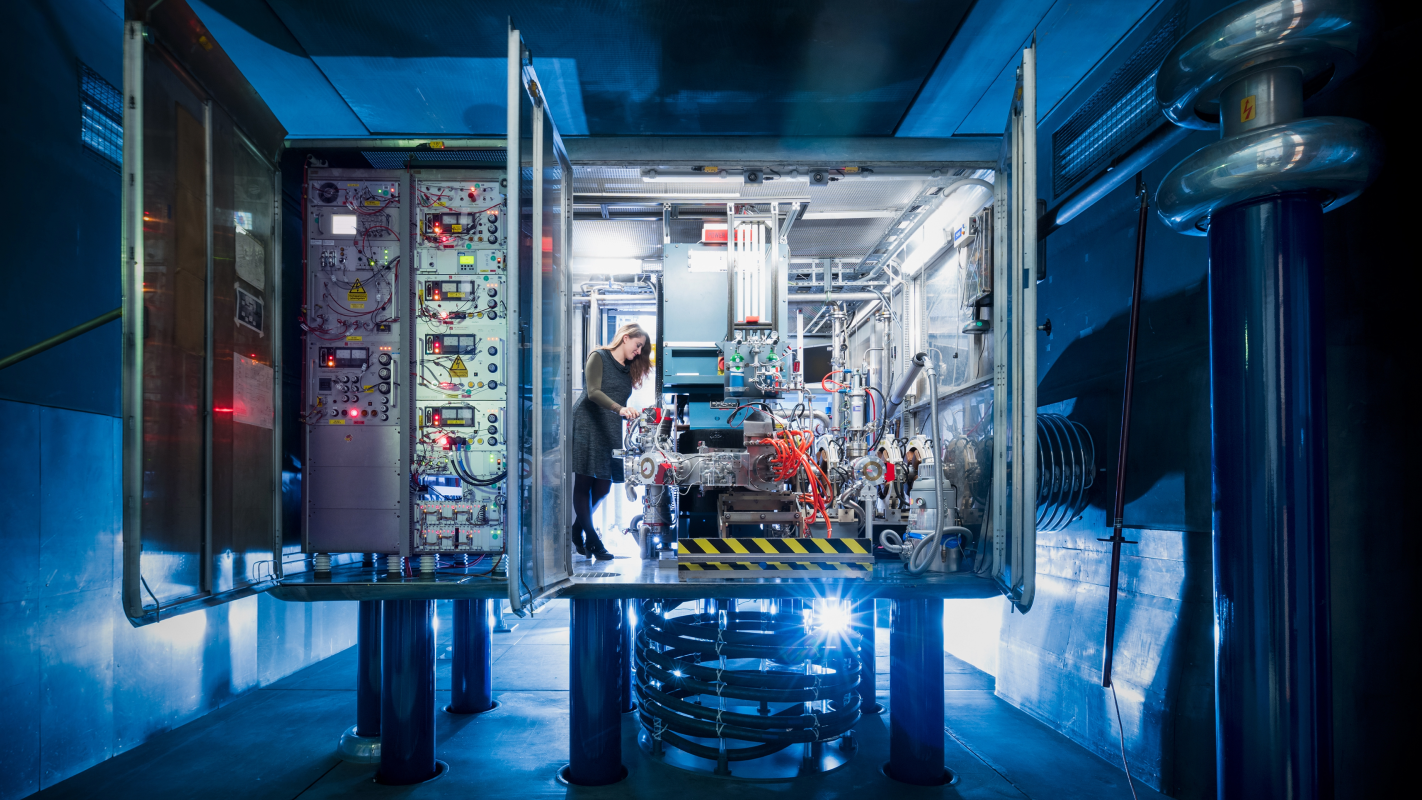
With the new trilateral master's program “Particle Accelerator Science” the Rhine-Main universities are pooling their expertise in accelerator science, which is unique in Europe. Starting in the summer semester of 2026, students will have access for the first time to a joint, internationally oriented program of study at three locations, covering the entire spectrum of this key technology. The closely interlinked exchange of research, teaching, and large-scale infrastructure creates a qualification profile that is unique in Germany.
The Rhine-Main region is a shining star in the universe of accelerator science. Nowhere else in Germany or Europe can you find such a high concentration of large-scale facilities, research institutions, and universities specializing in this discipline as in the region around Frankfurt, Darmstadt, and Mainz. “Together, we have unique expertise in accelerators,” says Holger Podlech, professor at the Institute for Applied Physics at Goethe University Frankfurt. In order to combine and coordinate their strengths and create tailor-made training for research and industry, the Rhine-Main Universities (RMU) are offering the new trilateral master’s program “Particle Accelerator Science” starting in the summer semester of 2026. For the first time, students in this international, English-language program will attend lectures, seminars, and internships at the Technical University of Darmstadt, Goethe University Frankfurt, and Johannes Gutenberg University Mainz. Joachim Enders, Professor for experimental and technical nuclear physics at TU Darmstadt, emphasizes that this unique program in accelerator science brings together five departments at three universities in the two federal states of Hesse and Rhineland-Palatinate and is part of the RMU Alliance’s Excellence Initiative.
The initiators and those responsible have spent several years working on the framework conditions and content of the first trilateral master’s program, which also includes cooperation with the GSI Helmholtzzentrum für Schwerionenforschung in Darmstadt, where currently FAIR is being built, one of the world’s largest accelerator facilities. However, the new master’s students will also be able to conduct research at local accelerator and test units in the respective physics departments of the three RMU universities. “Together, we offer a much more comprehensive study of accelerator science than any university could achieve on its own,” says Prof. Enders, emphasizing the potential of the joint program. The program will teach different perspectives and applications in a very broad and interdisciplinary curriculum that encompasses not only physics, but also engineering aspects such as electrical engineering and materials science. “Our goal,” says Prof. Kurt Aulenbacher from the Institute of Nuclear Physics at Johannes Gutenberg University Mainz, “is to provide students with general knowledge, not just specialized knowledge.”
During the four semesters, students take compulsory and elective courses as well as research and project phases. Credit points must be earned at all three universities. “Those who successfully complete the ‘Particle Accelerator Science’ program will have a triple degree from Frankfurt, Darmstadt, and Mainz. That is unique,” emphasizes Prof. Aulenbacher. Initially, 20 admissions per semester are planned, 40 per year — a personal and intensive degree program. The program is aimed at bachelor’s students at RMU universities, but also at interested students from other universities and international applicants. Registration begins on December 1, 2025, at TU Darmstadt, which is leading the trilateral program starting in April 2026.
The students will be the sought-after specialists of tomorrow. The accelerator community needs young talent. “We don't have enough experts who are knowledgeable in accelerator science,” says Prof. Podlech. The fields of application are diverse: In fundamental research in nuclear and particle physics, accelerators are used to search for the origin of the universe, the Higgs boson, or dark matter, for example. There are also applications in biology, biophysics, and medical technology, and new cancer and tumor therapies or drugs have been developed in this way. With the help of accelerator science, seeds can be freed from harmful germs and X-ray light of incredible brilliance and laser quality can be generated, as well as neutrons, which in materials research enable new materials, welding processes, and fusion materials, among other things. “Accelerator technology can be used for climate research, energy transition, or security tasks. The number of applications is virtually unlimited,” says Prof. Podlech. Students of the RMU master’s program, his TU colleague Enders is certain, “will be well trained for research, higher education, or business.”
Downloads
- RMU press release dated 1 December 2025 (253.67 KB)