When Writing Fades but Meaning Endures: How Markus Scholz Deciphered Roman Wax Tablets from Belgium
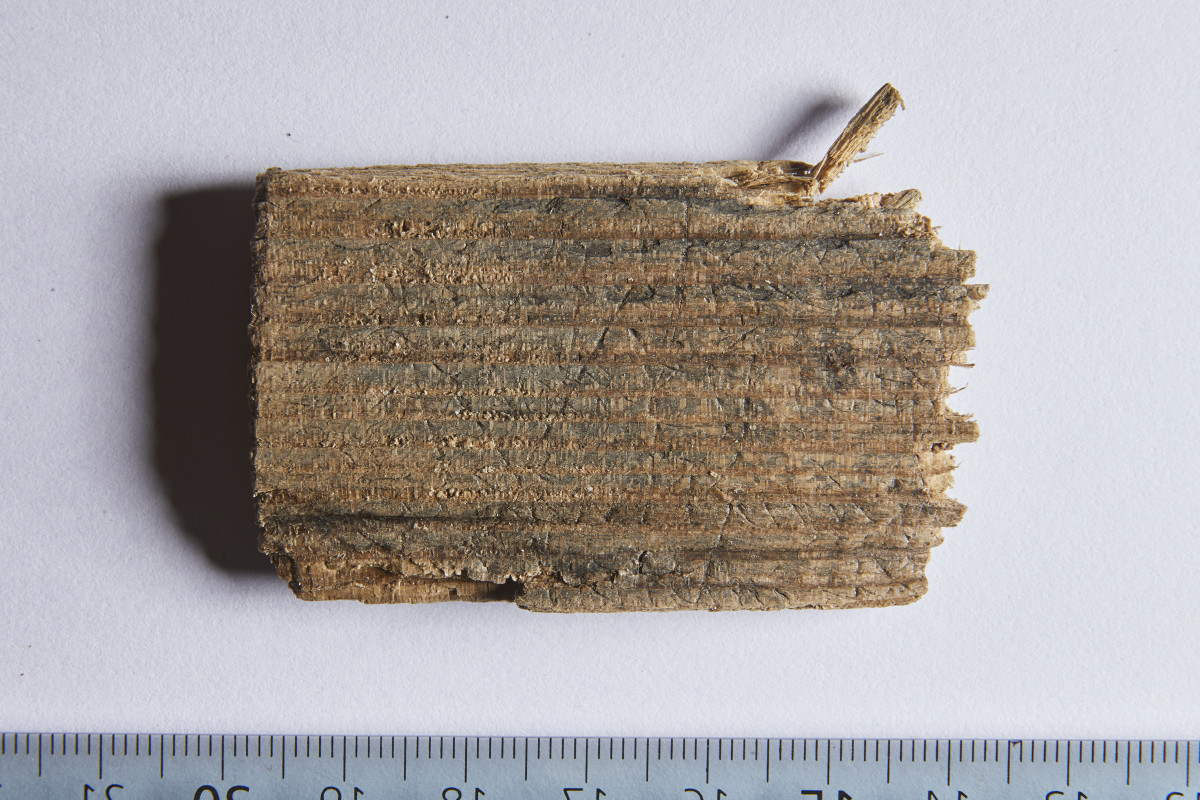
Atuatuca Tungrorum / Tongeren. Fragment of a wooden writing tablet (Cat. No. 32) mentioning honourably discharged fleet soldiers (classici). Photo: © Gallo-Roman Museum Tongeren
A year ago, Professor Markus Scholz, a specialist in provincial Roman archaeology and ancient inscriptions at Goethe University Frankfurt, found himself responding to an unusually high number of media inquiries. The reason was his team’s deciphering of the so-called Frankfurt Silver Inscription, which attracted worldwide attention by providing evidence that belief in Jesus Christ had already spread north of the Alps by the 3rd century CE. Scholz’s persistence and expertise have now contributed to another remarkable deciphering achievement. Together with Professor Dr. Jürgen Blänsdorf (emeritus at Johannes Gutenberg University Mainz), he has identified previously unreadable writing preserved on the wooden remains of Roman wax tablets discovered in Tongeren, Belgium.
Tongeren is widely regarded as Belgium’s oldest city. Located in the eastern province of Limburg, it traces its origins back to the Roman settlement of Atuatuca Tungrorum, which was likely destroyed during the Hunnic invasions in 451 CE. Archaeological remains from the Roman period continue to surface in the city to this day. In the 1930s, a large number of wooden fragments were excavated and initially interpreted as parts of planks or boxes. Only later did it become clear that they were in fact the wooden frames of Roman wax tablets. These tablets once held a millimetre-thin layer of wax that served as a writing surface for a wide range of everyday and official purposes. When letters were inscribed into the wax with a stylus, the pressure often left faint impressions in the wood beneath. It was these traces that required deciphering. The wax itself has long since disappeared. At the time of the excavation, scholars assumed that no writing had survived, and the finds were largely forgotten until 2020, when Else Hartoch, Director of the Gallo-Roman Museum in Tongeren, brought them back to scholarly attention.
More Challenging to Decipher than the Silver Inscription
Hartoch knew exactly whom to contact for this demanding task. In 2021, at the height of the COVID-19 pandemic, Markus Scholz took on the challenge and, with the support of Jürgen Blänsdorf, succeeded in uncovering a wealth of information. Compared with the silver inscription, this material proved far more difficult to interpret. “The wood, with its natural grain, was completely dried out,” Scholz explains. “Distinguishing between grooves that formed part of a letter and those caused by cracks, damage, or the drying process itself was extremely challenging.” These obstacles were significantly greater than those encountered with the amulet from Roman Nida, particularly because many of the tablets had been reused, creating overlapping palimpsests.
The 85 surviving fragments came from two different archaeological contexts. One assemblage was recovered from a well near the forum and other public buildings, where the tablets appear to have been deliberately destroyed and discarded. Throwing them into the well likely ensured that the information they contained could no longer be read — perhaps an ancient form of data protection. As Scholz and Blänsdorf discovered, many of these texts were contracts or official records. “When drafting contracts, scribes deliberately applied strong pressure so that the writing would be deeply impressed into the wood,” Scholz explains. The second group of fragments came from a muddy depression that was apparently filled with worn-out tablets and other refuse to aid drainage. Here, researchers also identified different types of texts, including administrative copies and pupils’ writing exercises — often the final use of already reused tablets — as well as a draft inscription intended for a statue of the future Emperor Caracalla, dating to 207 CE.
The deciphering process was painstaking, Scholz notes. Although the team employed advanced visualization techniques such as Reflectance Transformation Imaging (RTI) using a dome system, progress was often slow. “Despite the pandemic, we had to meet in person again and again to study the originals — always wearing face masks,” Scholz recalls. During these sessions, each researcher presented interim findings, which were then discussed and refined together, gradually yielding further insights.
Evidence of High Offices and Cultural Diversity
Only about half of the 85 fragments preserve identifiable traces of writing. Even so, the deciphered letters, words, and names have yielded significant historical insights. Among them is evidence that high political offices were also held in the Roman provinces. The tablets mention a decemvir, a senior magistrate, as well as lictores, attendants to leading state or municipal officials — roles that had previously been very rarely documented in the northern provinces of the Roman Empire. The texts also shed light on the people who lived in the region. Some individuals appear to have settled in Tongeren after completing their service in the Roman military, including veterans of the Rhine fleet. The names recorded on the tablets point to a remarkably diverse population, encompassing Celtic, Roman, and Germanic origins. Several of these names were previously unknown from other sources.
For Markus Scholz, the work proved just as compelling as his research on the widely discussed amulet from Roman Nida, located in what is now Frankfurt’s Heddernheim district. Although the material itself may seem modest and the inscriptions less spectacular at first glance, the deciphering of the wax tablets has made a substantial contribution to Roman archaeology and ancient history.
Literature: Else Hartoch (ed.), The writing tablets of Roman Tongeren (Belgium) and associated wooden finds (Turnhout 2025). (S. 21-32 Abschnitt 1.2 über die entzifferten Texte und ihre Bedeutung sowie kommentierter Katalog S. 185-280 Catalogue Part 1; S. 281-314 Catalogue Part 2 by Jürgen Blänsdorf and Markus Scholz)
Text: Dr. Anke Sauter, Goethe-Universität Frankfurt